

Contact Details:
+86 17852488518

Product Overview
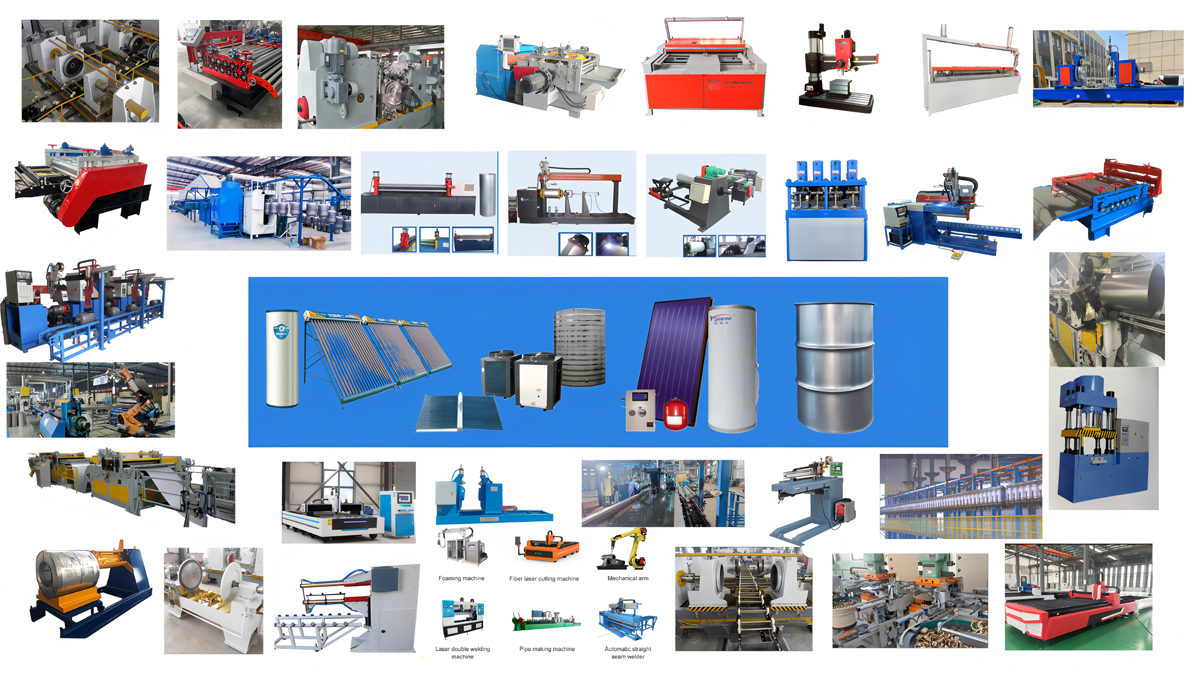
The can sealing machine is a key piece of equipment in a Steel Drum Production Line. It is mainly used for the automatic pressing, edge rolling, and sealing of steel drum lids and bodies. It is suitable for the production of 200L open-top drums, closed-top drums, chemical drums, oil drums, and various metal packaging containers. The equipment adopts a PLC automatic control system, a hydraulic drive structure, and a high-precision positioning device, enabling stable and continuous can sealing operations, ensuring tight sealing, smooth edges, and reliable sealing performance. This equipment features a high degree of automation, fast operation, simple operation, and convenient maintenance. It can be matched to different drum specifications and production capacity requirements according to customer needs. Typically equipped with a 380V industrial power supply, it supports integrated operation with rolling machines, longitudinal seam welding machines, flanging machines, corrugating machines, and spraying equipment in the steel drum production line. It is suitable for medium- and high-speed automated steel drum production lines, improving production efficiency and reducing labor costs.


You know what keeps me up at night when I think about steel drum production? It's not the welding or the forming. It's the
very last step: the seaming process. That's where your drum goes from being a collection of parts to a finished container. And
if that last step isn't perfect, everything you did before it—the shearing, curling, welding, flanging, and beading—is wasted.
That's why I always tell factory owners to treat their Steel Drum Sealing Machine with the same respect they give their welder.
It's the machine that puts the final seal on your product, and it deserves your full attention.
A Steel Drum Seaming Machine, sometimes called a closing machine or sealer, is the equipment that attaches the lid to the
drum body by rolling the two edges together into a tight, interlocked joint. The process is called double seaming, and it's
been the industry standard for decades. The machine uses two sets of rollers: the first operation roller hooks the lid edge
around the body flange, and the second operation roller compresses that hook into a tight, five-layer seam. When it's done
right, that seam is strong enough to hold the drum together even when it's dropped from a height or stacked four high. When
it's done wrong, you get leaks.
If you're in the market for a sealing machine, you'll quickly find there are two main configurations: single-sided and
double-sided. A single-sided seamer works on one end of the drum at a time. You seal the bottom, flip the drum, and seal the
top. It's slower, but it's cheaper and easier to maintain. A double-sided seamer works both ends at the same time. It's faster
and more consistent, but it costs more and requires more precise setup. If you're running a high-volume line producing
hundreds of drums an hour, the double-sided is usually the better investment because it cuts your cycle time in half and
ensures both ends are sealed identically.
Now, here's something that surprises a lot of people: the seaming machine's performance depends heavily on the condition
of those seaming rollers. They wear down over time, and when they do, the seam shape changes. The hook on the lid edge
doesn't engage properly. The compression isn't even. And that's when you start getting leaks. A good maintenance program
includes regular inspection of the rollers and replacing them when they show signs of wear. Some modern seamers even
include a seam thickness monitor that gives you real-time feedback on every drum, so you know immediately if something's
drifting out of spec.
Here's a practical tip I've picked up over the years: always check your seaming compound supply before you start a shift. The
sealing compound—the glue that's applied to the lid before seaming—is what fills the microscopic gaps between the steel
layers. If the compound runs out mid-shift, you'll get drums that look perfectly seamed but leak at the first drop test. A
simple visual check of the compound level at the start of each shift can save you from a batch of rejects.
Another thing to consider is the automation level. A semi-automatic seamer requires an operator to place the lid and start the
cycle. A fully automatic seamer takes the drum from the conveyor, positions the lid, seals it, and sends it to the next station
without anyone touching it. The semi-automatic is fine for lower-volume lines or where labor is cheap. The fully automatic is
what you want when you're running hundreds of drums an hour and you need consistent quality with minimal labor. If you're
upgrading from manual to automatic, you'll be amazed at how much your consistency improves—and how much lower your
labor costs go.
One more thing: if you're running a fully automatic line, make sure you have a downstream leak tester to catch any seam
failures before the drums get to your warehouse. No seaming machine is perfect forever—but a leak tester is a safety net that
gives you the peace of mind to ship with confidence.
Your steel drum seaming machine is the final step in your production line. When it's working right, it turns your hard work
into a finished product. When it's not, it turns your hard work into scrap. Choose wisely, maintain carefully, and your drums
will seal tight every time.


This website uses cookies to ensure you get the best experience on our website.


 Español
 Pусский
 Français
 العربية



 Phone
Phone