

Contact Details:
+86 17852488518

Product Overview
A rolling machine is a key piece of equipment on a Steel Drum Production Line, transforming flat steel sheets into cylindrical
drum bodies. It's located after leveling and shearing and before spot welding. Simply put, it "rolls" the cut rectangular steel
sheets into a cylinder, preparing for the subsequent longitudinal seam welding.
Currently, the most commonly used rolling machine in the steel drum industry is the three-roll symmetrical rolling machine.
Structurally, it consists of a frame, an upper roller, two lower rollers, and a transmission device. The upper roller is located
directly above the two lower rollers and can be adjusted vertically; the two lower rollers are driven by an electric motor to
rotate in the same direction and at the same speed. During operation, the steel sheet is fed between the upper and lower
rollers. As the lower rollers rotate, friction propels the sheet forward, while the upper roller applies pressure. As the sheet
passes between the three rollers, it is evenly bent into an arc shape.
However, the three-roll rolling machine has a significant drawback—straight edges are left at both ends. This is because at
the very beginning and near the end of the sheet's movement, a section at each end does not contact the upper roller and
thus cannot be bent. This straight edge section, approximately 50 to 100 millimeters long, can cause indentations near the
weld seam of the barrel, affecting its roundness. To address this issue, some factories use a bending press for pre-bending
or add a rounding machine later for correction.
The quality of the rolling directly affects the subsequent welding effect. Several key process parameters apply: the rolling
curvature must be uniform; the diameter difference between the two ends of the barrel should not exceed 50 millimeters;
the two ends must be aligned, with a misalignment error of no more than 5 millimeters; and a 100 to 150 millimeter overlap
should be allowed at the longitudinal seam for welding.
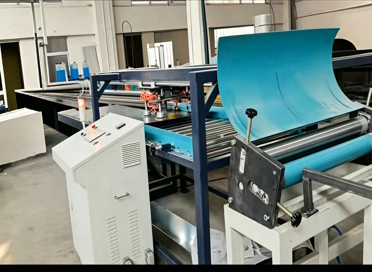


The One Machine That Shapes Your Entire Steel Drum: The Rolling Machine
I’ve walked into quite a few steel drum factories where the owners are laser-focused on the welding or the painting, but
they barely give a second thought to the rolling machine. That’s a mistake. Because if that steel sheet doesn’t get rolled
into a perfect cylinder right at the start, nothing else you do after that will fix it. You can have the best welder in the world,
but if the edges don’t line up because the rolling was sloppy, you’re fighting a losing battle.
So, let’s talk about the rolling machine for your Steel Drum Production Line. What does it actually do? In simple terms, it
takes that flat, rectangular piece of steel you just cut and bends it into a round barrel body. It’s the step right after the
shearing machine and right before the seam welder. And the type of rolling machine you choose will determine how round
your drums are, how strong they are, and how much headache you have down the line.
The Classic: The Three-Roller Rolling Machine
The most common type you’ll see is the three-roller rolling machine . It’s a pretty straightforward piece of gear. You’v
got two lower rollers side-by-side that rotate and pull the steel sheet through. Above them, centered right in the middle, is a
third roller that presses down on the metal. As the sheet passes through, it gets bent into a curve. This works great, but there
’s a catch. That setup leaves a flat spot, or what we call a "straight edge," on both ends of the steel sheet. That’s because
the top roller can’t press on the very ends as they go in and come out. That straight edge means your barrel won’t be
completely round, which makes welding tricky and leaves you with a dent near the seam . To deal with that, a lot of factories
end up using a pre-bending machine or a correction machine later on to round it out properly .
The Upgrade: The Hydraulic Two-Roller Machine
Now, there’s a smarter option that’s been gaining a lot of traction: the hydraulic two-roller rolling machine. This thing is
a different beast entirely. Instead of three rollers, it uses two that work together almost like a pasta maker. One roller is fixed,
and the other one presses the steel against it under heavy hydraulic pressure . The beauty here is that it eliminates that
straight edge problem entirely. It forms the whole cylinder in one smooth pass, which means a perfectly round barrel body
right out of the gate. This is a huge benefit because you get better accuracy and it saves you time. Plus, since it’s hydraulic,
you can handle thicker steel with less effort and get more consistent results across a long production run.
What Matters Most: The Machine That Fits Your Line
So, which one should you choose? The answer depends on your speed and your steel.
For a low-speed line cranking out just one or two drums per minute, a basic three-roller machine might be perfectly fine,
especially if your steel is on the thinner side, like 0.8mm to 1.2mm . It’s a simple, reliable workhorse that won’t break the
bank. But if you’re running a medium or high-speed line that needs to pump out five to eight drums a minute, you need
something more efficient and precise . That’s where a fully automatic rolling machine with hydraulic control becomes a
game-changer.
When you’re talking to suppliers, you want to ask some specific questions. First, ask about the material of the rollers. Are
they solid forged steel with heat treatment? That’s what you want because it means they’ll last longer and keep their
shape under heavy loads . Second, find out about the leveling and control system. A machine with a PLC controller is great
because you can set the parameters once and let it run, making sure every single drum body is exactly the same . Finally, ask
about the accuracy. A good rolling machine will keep a tolerance of plus or minus a millimeter, which is critical for getting a
tight, weldable seam.
At the end of the day, the rolling machine is where the shape of your steel drum is born. It’s the starting point for quality.
Getting it right means your drums are round, your welds are strong, and your customers are happy with a product that’s
built to last. Get it wrong, and you’ll be spending time and money fixing problems that shouldn't have existed in the first
place.
 RELATED
 RELATED


This website uses cookies to ensure you get the best experience on our website.


 Español
 Pусский
 Français
 العربية



 Phone
Phone