

Contact Details:
+86 17852488518

Product Overview
This corrugating machine is a core forming piece in the middle section of a Steel Drum Production Line. Located after the
flanging and rib-expanding process and before the sealing process, it rolls clear, annular corrugations onto both ends of the
drum body, significantly improving the drum's rigidity and resistance to deformation. The machine adopts a horizontal
double-spindle box structure, with the left and right spindle boxes sliding on the base guide rails and driven synchronously by
a hydraulic system to ensure accurate and consistent corrugation position and depth at both ends of the drum.
The main drive of the machine is achieved by a motor driving the spindle rotation via a pulley and helical gears. The pressing
and lifting of the upper corrugating roller is controlled by a pressing cylinder, and the pressing stroke can be flexibly adjusted
via limit switches. The processing range covers drum diameters of 560~571.5mm, drum lengths of 725~950mm, and wall
thicknesses of 0.6~1.25mm. It can press multiple corrugations according to the GB/T 325 national standard. The spindle
speed is approximately 340 r/min, the main motor power is 7.5kW, the hydraulic system pressure is 6MPa, and the production
line speed can reach 5~10 drums/minute. The entire machine adopts a welded box-type base structure, and the guide rail
surface is equipped with a lubrication system to ensure smooth sliding. The electrical control system supports PLC control
and can be connected with a flanging machine and a rib-expanding machine to form a fully automatic intermediate forming
line, or it can operate independently as a semi-automatic standalone machine. The corrugated rollers are made of high-strength
alloy steel and are treated with a special process to ensure service life. The roller position and corrugation depth can be
quickly adjusted according to the barrel shape and specifications, making it a key piece of equipment for steel barrel
manufacturers to improve the structural strength of their products.
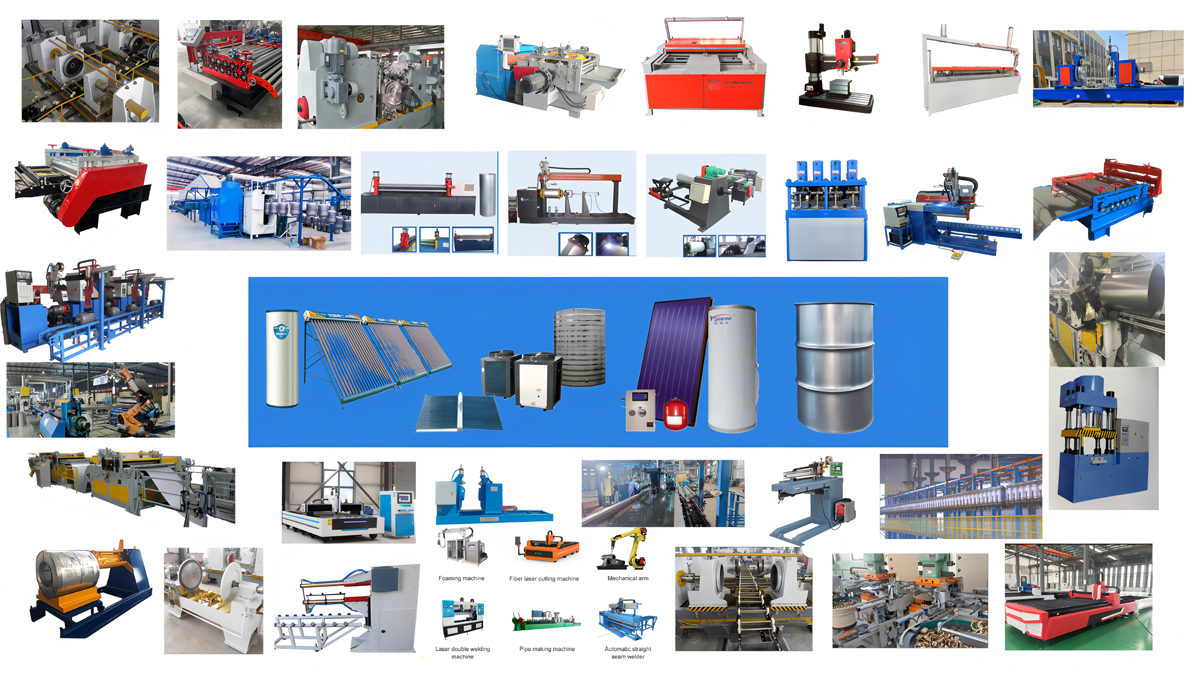


The Steel Drum Beading Machine: The Unsung Hero That Keeps Your Barrels From CrushingI’ll be honest with you—when most people look at a steel drum, they don’t think about the ridges running around
the middle. They just see a container. But those ridges, which we call beads or corrugations, are what keep that drum
from turning into a crushed pancake the first time someone stacks another drum on top of it. And the machine that puts them there is called a steel drum beading machine, or as some folks call it, a corrugating machine.
Here’s what happens if you skip this step or use a machine that doesn’t do its job right. Your drum bodies are basically just
thin steel cylinders. They’re strong enough to hold liquid, but stack them three or four high, and the weight of the drums
above starts pressing down on the ones below. Without those beads, the sidewalls buckle inward. And a buckled drum?
That’s a leaky drum, or worse—a drum that splits open. I’ve walked through factories where the reject pile was nothing
but collapsed barrels, and in almost every case, the problem was a beading machine that wasn’t set up correctly.
So what does a beading machine actually do? It takes a finished drum body—already rolled into a cylinder and welded—and
uses a set of expandable dies that go inside the drum from both ends . The machine pushes those dies outward against the
steel, forcing the metal to deform outward and form a raised ridge. This process is sometimes called "bead expanding," and
it’s been the industry standard for decades because it adds structural strength without adding extra material . Some
machines use a purely mechanical drive, while others use hydraulic cylinders to control the expansion. And then there are
the newer designs that combine both—a mechanical drive for moving the heads in and out quickly, and hydraulic power for
the actual bead-forming action . That combination gives you the speed of a mechanical system with the precision and
smoother operation of hydraulics.
Now, if you’re in the market for a beading machine for your Steel Drum Production Line, here’s what you need to think
about. First, consider whether you want a standalone corrugating machine or a combination unit that does flanging and
beading together. A combination machine can do two jobs in one pass—it forms the flange on the drum edge and rolls the
beads in the body. Grotnes, for example, offers a flanger/curler-beader that can switch between tooling sets in minutes, which
is great if you run different drum sizes . But if you’re running high volumes of the same drum size day in and day out, a
dedicated beading machine might give you better consistency.
Second, think about automation. A fully automatic beading machine with PLC control can run at 5 to 8 drums per minute on
a mid-speed line, and up to 10 on a high-speed line . Semi-automatic machines are cheaper and easier to maintain, but you’re
relying on an operator to load and unload each drum, which caps your speed and introduces human error. I always tell factory
managers to look at their production volume over the next five years, not just today. If you’re going to grow, buy the
automatic version now—retrofitting later costs more.
Third, pay attention to bead height and position. Different drum designs require different bead heights and distances from
the drum ends . A good machine lets you adjust these settings without tearing the whole unit apart. Some modern machines
even let you save different recipes for different drum specs, so when you switch from a 200L closed-top to a 210L open-top,
the machine adjusts automatically.
Let me give you a practical tip from my own experience. When you’re checking out a beading machine, bring a sample of
your steel—same thickness, same grade. Run a few drums through it and measure the bead height with a gauge. Then have
your quality team drop-test a few of those drums. I’ve seen machines that looked great on paper but couldn’t form a
consistent bead once the steel thickness varied by 0.1mm. That little difference is enough to make your beads shallow on
some drums and too deep on others. And inconsistent beads mean inconsistent drum strength.
One more thing—don’t overlook the beading dies themselves. These are the tools that actually push against the steel.
They wear out over time, and when they do, your bead quality drops. A good supplier will tell you how many cycles you can
expect from a set of dies and will stock replacements so you’re not waiting weeks for new ones. Some manufacturers, like
Grotnes, have engineered their machines so die changes can be done in minutes . That’s the kind of detail that separates a
good machine from a great one.
The bottom line is this: your steel drum beading machine isn't just adding decorative lines to your barrels. It's building the
structural integrity that lets your drums survive shipping, stacking, and handling. Whether you choose a mechanical,
hydraulic, or hybrid machine, make sure it gives you consistent bead depth, easy adjustability, and quick die changes.
Because once those drums leave your factory, they're on their own—and you want them to hold up long after they've been
loaded onto a truck.
 RELATED


This website uses cookies to ensure you get the best experience on our website.


 Español
 Pусский
 Français
 العربية



 Phone
Phone