

Contact Details:
+86 17852488518

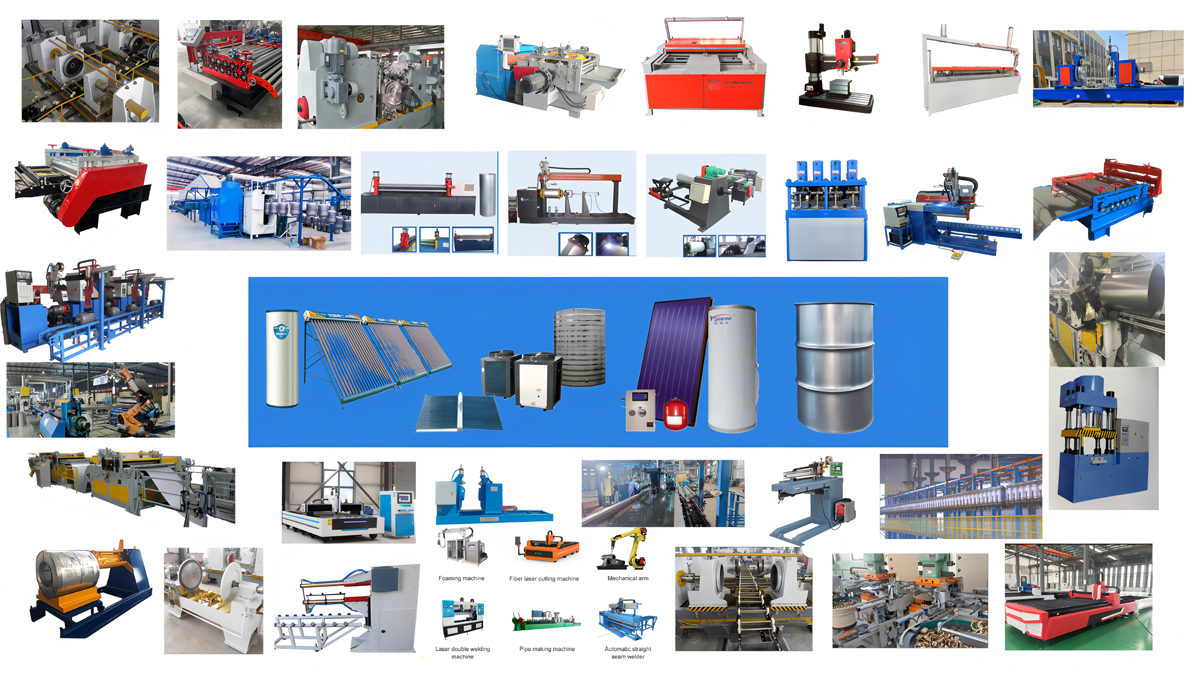
Product Overview
This shearing machine is a core piece of equipment in the front-end process of a Steel Drum Production Line. It is used to cut
steel coils into rectangular sheets for the drum body and bottom/top according to process requirements after uncoiling and
leveling. The equipment is hydraulically driven, equipped with a PLC automatic control system and a servo-driven fixed-length
feeding mechanism. The shearing thickness range is 0.6~1.5mm, the maximum shearing width is 1600mm, the fixed-length
accuracy is ≤±0.5mm/2m, and the shearing frequency can reach 15~18 times/minute. It is suitable for the batch production
needs of 200L and 210L standard steel drums.
The entire machine uses an all-steel welded frame, which undergoes overall annealing treatment to eliminate internal stress
and ensure no deformation during long-term use. Both upper and lower blades are made of imported high-strength alloy
steel, which is wear-resistant, durable, and can be repeatedly sharpened. The blade gap can be quickly adjusted via handwheel
or electric means. The equipment comes standard with a front pneumatic pressure plate and a rear gauge system, and can be
optionally equipped with an automatic stacking and alignment device and conveyor rollers. It supports single-sheet shearing
or stack shearing modes. This machine can be linked with an uncoiler and a leveler to form a complete uncoiler, leveling and
shearing production line, or it can be used independently for fixed-length shearing of flat materials. It is a basic piece of
equipment for steel drum manufacturing enterprises to achieve precise material utilization and stable production.


Let me start with a confession: when I first started helping steel drum factories set up their production lines, I used to think the shearing machine was the boring part. It’s just a big pair of scissors, right? Cut the steel, move on. What could possibly go wrong? Then I spent a few years watching factories struggle with welded seams that wouldn’t hold, drum bodies that didn’t line up, and material waste that ate into their profits. And you know what the culprit was almost every time? The shearing machine.
Here’s the thing that a lot of people miss. A steel drum isn’t just a round container—it starts as a flat, rectangular piece of
steel that gets cut by your shearing machine. That piece becomes the drum body. Another set of pieces become the bottom
and the lid. If those pieces aren’t cut accurately—and I mean really accurately—nothing else on your production line matters.
Your welding machine can’t fix a gap that’s already there. Your seamer can’t seal a drum that wasn’t round to begin with.
Everything downstream depends on that first cut.
So let’s talk about what you actually need to know when you’re looking at a shearing machine for your steel drum
production line. There are three types you’ll run into: manual, hydraulic, and CNC. And the choice between them isn’t just
about how much money you want to spend—it’s about what kind of production you’re running.
Manual shears** are the cheapest option. You measure the steel by hand, you position it by hand, and you pull a lever or press
a button to make the cut. They work fine if you’re making a couple hundred drums a day and your operators are experienced.
But here’s the catch: the accuracy depends entirely on who’s standing at the machine. One guy’s tired on a Friday afternoon,
and suddenly your blanks are coming out a millimeter too long. That doesn’t sound like much, but on a steel drum, a millimeter
off means the body won’t meet the lid properly. And that means leaks.
Hydraulic shears** are a step up. They use hydraulic cylinders to push the blade down, which gives you more consistent force
and cleaner cuts. Most steel drum factories I’ve visited run hydraulic shears because they handle thicker steel—think 0.8 to
1.5mm sheet thickness—without struggling. The real advantage here is that hydraulic machines can hold tighter tolerances
than manual ones, especially if they have a digital back gauge that positions the steel automatically. A good hydraulic shear on
a steel drum line can hold a cutting tolerance within plus or minus 0.5 millimeters over a two-meter sheet. That’s the kind of
precision that keeps your welds tight and your customers happy.
cnc shears** are where things get really interesting. These machines are fully programmable. You punch in the cutting
sequence—how many blanks of what length, in what order—and the machine does the rest. The back gauge moves automatically
between cuts, and the blade gap adjusts itself based on the material thickness. For high-volume steel drum production, a CNC
shear is a game-changer because it eliminates human error almost entirely. You can run a whole shift and every single blank
will be the exact same size.
Now, let’s get practical. Here’s what you need to check when you’re choosing a shearing machine for your steel drum
line:
First, look at the cutting capacity.** The machine needs to handle your maximum sheet width and thickness. Most steel drums
use steel that’s 0.8 to 1.2mm thick, so you don’t need a monster machine. But if your supplier offers a model that cuts up
to 3mm, that gives you flexibility to run different products.
Second, pay attention to the blade clearance.** This is one of those details that makes or breaks your cut quality. If the gap
between the upper and lower blades is too small, you’ll wear out your blades fast. If it’s too big, you’ll get burrs and
rough edges. For steel drums, the clearance should be set at around seven percent of the material thickness. On a good
machine, this setting is easy to adjust and clearly marked.
Third, don’t skimp on the back gauge.** This is the mechanism that positions the steel sheet before each cut. On cheap
machines, it’s flimsy and drifts out of calibration. On good ones, it’s built like a tank with hardened guide rails and a
reliable drive system. If you’re upgrading to a CNC shear, make sure the controller is from a reputable brand so you’re not
stuck with a machine that can’t hold its settings.
One more thing: think about integration. Your shearing machine doesn’t work in isolation. It sits at the front of your
production line, right after the uncoiler and the leveler. The steel comes off the coil, gets flattened, and then goes straight into
the shear. If these machines aren’t synchronized properly, you’ll end up with jams and bottlenecks. Look for a system that
includes a buffer pit or a loop control that stores a bit of steel between the leveler and the shear. That way, the leveler keeps
running continuously while the shear stops and starts for each cut.
Let me give you a real example. I worked with a factory that was running an old manual shear. They were cutting about 1,200
blanks a day, and their reject rate was around three percent. Doesn’t sound terrible, right? But when you do the math,
that’s 36 bad blanks every day. Each one of those blanks meant wasted steel, wasted labor, and a drum that had to be
scrapped. They upgraded to a CNC-controlled hydraulic shear with a digital back gauge. Their reject rate dropped to under
half a percent. Over a year, that saved them enough material and labor to pay for the new machine twice over.
The bottom line is this: your steel drum production line’s shearing machine isn’t just the first piece of equipment. It’s the
gatekeeper. If it makes a perfect cut, the rest of your line has a fighting chance. If it doesn’t, you’re fighting an uphill battle
all the way to the end. So don’t treat it like an afterthought. Get the machine that fits your production volume, your
material thickness, and your accuracy requirements. And if you’re not sure which one that is, ask someone who’s been
doing this for a while. They’ll tell you the same thing I’m telling you: the cut you make at the beginning determines the
quality you ship at the end.


This website uses cookies to ensure you get the best experience on our website.


 Español
 Pусский
 Français
 العربية



 Phone
Phone