heat treatment furnace
A heat treatment furnace is a specialized industrial machine used to control the heating and cooling of metal and other materials in order to change their physical and mechanical properties. It is widely used in manufacturing, metallurgy, automotive, aerospace, tooling, and other industries where precise material performance is required. By exposing workpieces to carefully controlled temperatures for specific periods of time, a heat treatment furnace can improve hardness, strength, toughness, wear resistance, ductility, and dimensional stability.The main purpose of a heat treatment furnace is to provide a stable and uniform thermal environment. Different heat treatment processes, such as annealing, quenching, tempering, normalizing, carburizing, nitriding, and stress relieving, require different temperature ranges and atmospheres. For this reason, heat treatment furnaces are designed with accurate temperature control systems, reliable insulation materials, and efficient heating elements or burners. Modern furnaces often use advanced control panels, sensors, and automated systems to ensure that temperature and time are maintained within strict limits.There are several types of heat treatment furnaces. Batch furnaces are used for processing individual loads or groups of parts at one time, making them suitable for flexible production needs. Continuous furnaces are designed for high-volume production, where materials move through the furnace in a steady flow. Other types include box furnaces, pit furnaces, vacuum furnaces, and atmosphere furnaces. Vacuum furnaces are especially important for high-precision applications because they prevent oxidation and contamination during processing. Atmosphere furnaces allow the use of protective gases to control the chemical environment around the material.The structure of a heat treatment furnace typically includes a heating chamber, insulation layer, loading system, temperature control system, and safety devices. The heating chamber must be built from materials that can withstand very high temperatures without deformation. The insulation layer helps reduce heat loss and improve energy efficiency. Temperature controllers and thermocouples monitor conditions inside the furnace to maintain accuracy. Safety systems are also essential to protect operators and equipment from overheating, gas leaks, or electrical faults.One of the key advantages of using a heat treatment furnace is the ability to improve product quality and consistency. By applying precise thermal cycles, manufacturers can produce parts with uniform properties and reduced internal stress. This leads to better performance, longer service life, and fewer defects. In addition, modern furnace designs focus on energy efficiency, lower emissions, and easier maintenance, which help reduce operating costs.In conclusion, a heat treatment furnace is an essential tool in modern industry. It provides controlled thermal processing that enhances material properties and supports the production of high-quality components. With continuous improvements in automation, temperature control, and energy efficiency, heat treatment furnaces remain vital equipment in many technical and manufacturing fields.
Products
Category:
-
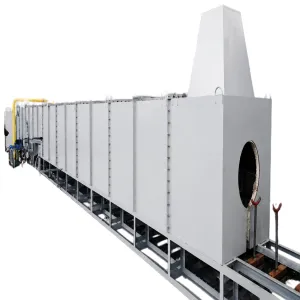
Gas cylinder heat treatment furnace
Category:
GAS cylinder production line
Browse number:
213
Number:
Release time:
2026-06-21 14:24:17
High Production Capacity Up to 50 t/h (walking beam type); 250 units/h (chain conveyor type); covers annealing, normalizing, quenching, and tempering
Precise Temperature Control Accuracy ±5°C, uniformity ±5°C across the entire length; complies with GB/T 9452 and TSG 07; zoned pulse combustion prevents direct flame impingement on workpieces
Superior Insulation Modular box-type structure; high-temperature castables, heavy-duty bricks, and aluminum silicate fiber insulation ensure low casing temperature rise
Heat-Resistant Drive System VFD-controlled gear reducer with high-temperature sprockets and chains; stainless steel supports (Φ22mm, 150mm spacing) ensure long-term stability at 600°C
Efficient Combustion 150,000 kcal/h high-velocity burners; three-zone pulse control; precise air-fuel ratio adjustment minimizes scale formation
Fully Automated Control Siemens PLC with 15-inch touchscreen; DCS integration; data storage and traceability; manual backup mode available for PLC anomalies
Waste Heat Recovery & Smart Line Flue gas waste heat preheats combustion air; compatible with quenching tanks, in-line hardness testing, and data uploading to meet smart factory requirements
Green & Energy-Efficient Pulse combustion saves 10–15% energy; waste heat utilization; supports natural gas, electric, or coal gas heating; no flue gas leakage; ISO14000 compliant
News
Category:
No search results found!
Case
Category:
No search results found!
Video
Category:
No search results found!
Download
Category:
No search results found!
Job
Category:
No search results found!
Featured Products
No search results found!





 Español
 Pусский
 Français
 العربية



 Phone
Phone